Germany's 2026 Residence Permit Digitalization & Job-Loss Buffer Explained
Two changes from late July 2026 matter to anyone renewing a German residence permit or facing a job loss: the MDWG lets authorities reuse your stored fingerprints, photo and signature so a straightforward eAT renewal may no longer need a fresh biometrics appointment, and § 18 AufenthG now grants fixed-term skilled-worker permits for the contract duration plus six months. Here is what each rule actually says, what it does not promise, and a copy-paste German email to ask your Ausländerbehörde for case-specific confirmation.
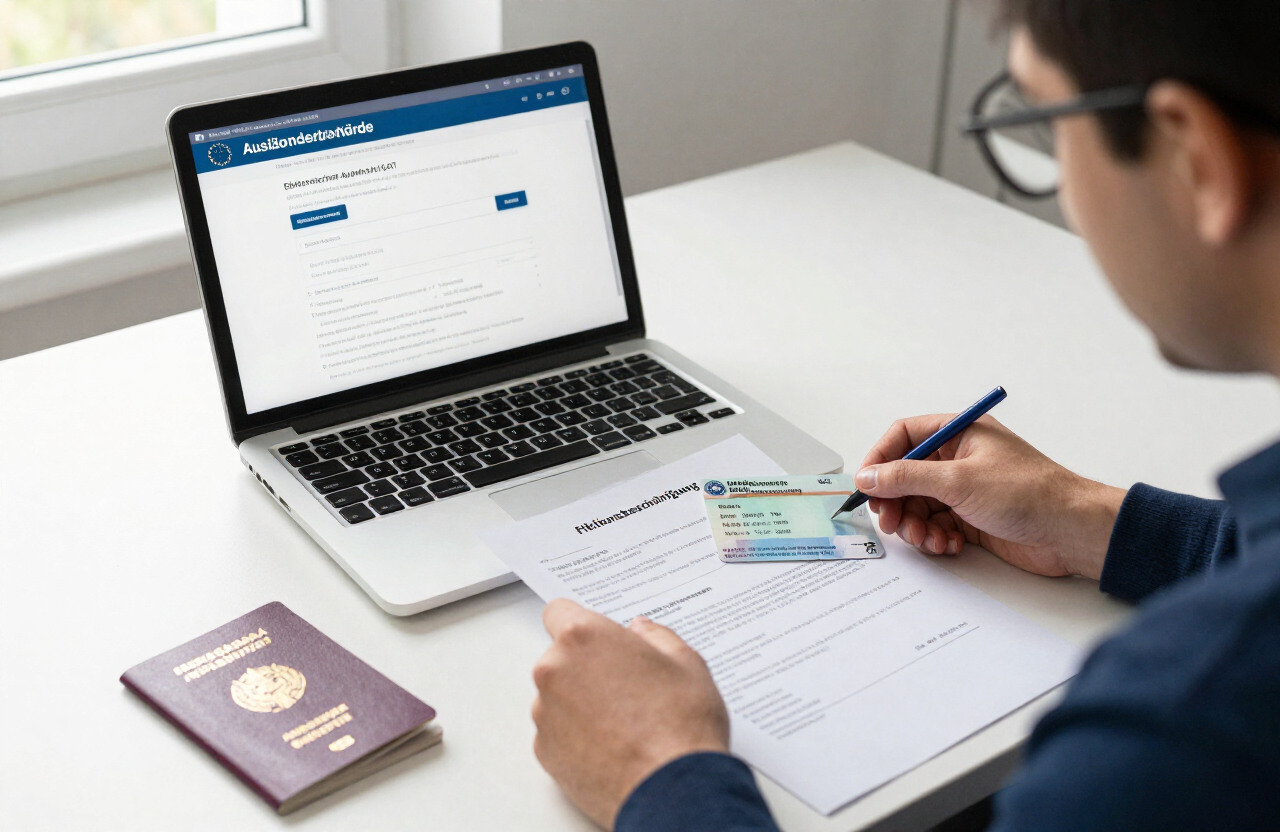
If you are renewing a German residence permit or worried about what happens to your status after a layoff, two changes that entered into force at the end of July 2026 are worth understanding — and worth not overestimating. The Gesetz zur Weiterentwicklung der Digitalisierung in der Migrationsverwaltung (Migration Digitalization Act, abbreviated MDWG, published as BGBl. 2026 I Nr. 222 on 28 July 2026) lets the immigration authorities store and reuse the fingerprints, photograph and signature they already captured, so a straightforward renewal of a temporary elektronischer Aufenthaltstitel (eAT) may no longer require a new in-person biometrics appointment. At the same time, § 18 of the Residence Act (Aufenthaltsgesetz) was amended so that fixed-term skilled-worker permits and EU Blue Cards are now issued for the duration of the employment contract plus six months, up from the previous three. This guide separates what each rule actually does from what it does not promise, distinguishes residence status, work authorization, permit expiry and statutory application effects, and gives you a copy-paste German email to ask your Ausländerbehörde for case-specific confirmation. Always confirm the current rules for your individual case with the Ausländerbehörde responsible for your place of residence before you act.
Practical checklist: protect your status if your permit is delayedSee the § 81(4) fiction, Fiktionsbescheinigung steps and a copy-paste German emailStored biometrics can be reused only in standard cases and only if your authority has implemented the new procedure — it is not an automatic right, and many local offices are still rolling it out in late 2026. Likewise, the longer permit duration and the job-loss search buffer are not automatic extensions: they apply when you next apply for or hold a qualifying permit, and the Ausländerbehörde decides your case on its facts. Do not assume your permit has been extended, and do not stop working or leave Germany without written confirmation of your status.
- The MDWG (BGBl. 2026 I Nr. 222, 28 July 2026) lets authorities reuse stored fingerprints, photo and signature for later applications, so a standard eAT renewal may no longer need a fresh biometrics appointment — but only where the authority has implemented it and your case qualifies.
- Since the end of July 2026, fixed-term skilled-worker permits under §§ 18a, 18b, 18g and 19c AufenthG are issued for the contract duration plus six months, up from the previous plus-three-months rule (§ 18 Abs. 4, in force since 1 March 2024).
- Reports describe a related improvement for workers whose job ends early: you should be left at least six months of residence to find a new position — and at least nine months where the employment ended because of exploitative conditions. Confirm your individual buffer with your Ausländerbehörde in writing.
- These residence-permit changes are separate from citizenship law: the three-year fast-track naturalization was abolished effective 30 October 2025, and the standard route is now five years under § 10 StAG. Do not confuse the two reforms.
The MDWG: Reusing Stored Biometrics for eAT Renewals
Before the MDWG, every renewal or replacement of an electronic residence permit (eAT) required a fresh in-person appointment to capture fingerprints, photograph and signature — one of the biggest drivers of the appointment backlog at large offices such as Berlin's Landesamt für Einwanderung (LEA). The Migration Digitalization Act, published on 28 July 2026 as BGBl. 2026 I Nr. 222, changes that: it lets the immigration authorities store the biometric data they already hold and reuse it for later applications, so a straightforward renewal of a temporary eAT no longer necessarily requires a new biometrics appointment in standard cases.
The same law expands the Central Register of Foreign Nationals (Ausländerzentralregister, AZR). Identity documents and visa-file documents — employment contracts, certificates and civil-status documents — can be stored centrally so that you do not have to resubmit them to every authority. Visa procedures go further digital from 1 November 2026, and from May 2028 the results of the integration-course language test (DTZ), the "Life in Germany" test and the naturalization test are to be stored in the AZR so you no longer have to re-prove them. None of this requires you to do anything proactively, but if you are renewing now it is worth asking your authority whether your stored biometrics can be reused.
| MDWG feature | What it does | Status / date |
|---|---|---|
| Biometrics reuse | Authorities may store and reuse fingerprints, photo and signature for later applications; a standard temporary-eAT renewal may skip a new biometrics appointment | In force since 28 July 2026; local implementation ongoing |
| AZR document storage | Identity and visa-file documents stored centrally so they need not be resubmitted to every authority | Rolling out from 2026 |
| Digital visa procedures | Visa procedures go further digital | From 1 November 2026 |
| Stored test results | DTZ, "Life in Germany" and naturalization test results stored in the AZR | From May 2028 |
The important caveat is that reuse is not guaranteed in every case. It applies to standard renewals of a temporary eAT where the stored data is still valid and sufficient; a new biometrics appointment may still be required for a first issue, a change of purpose, an upgrade to a permanent (Niederlassungserlaubnis) title, or where the stored data is outdated. Local offices are implementing the law at different speeds, so expect inconsistencies in the first months. If your renewal is urgent and your permit is about to expire, the protective effect of a timely renewal application under § 81(4) AufenthG still applies regardless of whether biometrics are reused — our guide to Ausländerbehörde delays and eAT renewals explains how that fiction works.
§ 18 AufenthG: Contract Duration Plus Six Months
The second change concerns how long a fixed-term skilled-worker permit lasts. Residence permits for skilled workers — the qualified-professional permits under §§ 18a and 18b AufenthG, the EU Blue Card under § 18g, and permits under § 19c — were previously issued for four years, or, if your employment contract was shorter, for the duration of the contract plus three months (§ 18 Abs. 4 AufenthG, in the version in force since 1 March 2024). Since the end of July 2026, that buffer has doubled: permits tied to a fixed-term contract are now issued for the duration of the employment relationship plus six months.
This matters most for people in academia, healthcare, IT consulting and project-based roles, where contracts are commonly shorter than four years. If you are on a permit issued under the old contract-plus-three-months rule, your existing permit remains valid as issued — the new duration applies when you next apply for or renew a permit. If your permit was issued under the old rule after late July 2026, question it. And if you hold an EU Blue Card, the 2026 salary thresholds and conditions in our Blue Card guide still apply alongside this duration change.
The Job-Loss Search Buffer: 6 Months, or 9 in Exploitative Cases
A related improvement, described in reporting on the July 2026 package, concerns workers whose employment ends earlier than planned. Under the new rules you should be left at least six months of residence to search for a new position — and at least nine months where the employment ended because of exploitative working conditions. This is a search buffer attached to your existing permit, not an automatic extension or a new residence title: it gives you time to find qualified employment and, if you do, to apply to switch or renew your title.
Do not assume your permit has automatically been extended after a job loss, and do not assume a universal grace period applies to every permit type. The buffer's length can depend on your permit, your Zusatzblatt (the supplementary sheet that sets your conditions) and the reason your employment ended. If your Zusatzblatt says something different, you may need to request it be updated. Notify your Ausländerbehörde in writing as soon as your employment ends, and get advice before accepting any shortening of your permit.
It is important to distinguish four things expats often conflate. Residence status is your lawful right to stay in Germany. Work authorization is the permission to take employment, usually noted on your Zusatzblatt. Permit expiry is the date your title ends. Statutory application effects — such as the § 81(4) Fortbestandsfiktion — are what happens to your status while a timely renewal application is being decided. The job-loss buffer concerns the first two within the period your permit is still valid; it is not the same as the fiction that protects you after you apply to renew. If you are unsure which applies, ask the Ausländerbehörde in writing and keep the reply.
| Concept | What it means | Where to check |
|---|---|---|
| Residence status | Your lawful right to stay in Germany under your residence title | Your eAT and Aufenthaltserlaubnis document |
| Work authorization | Permission to take employment, including any employer or hours restriction | The Zusatzblatt supplementary sheet |
| Permit expiry | The date your current title ends | The "gültig bis" field on your eAT |
| Statutory application effect | What happens to your status while a timely renewal is decided (e.g. § 81(4) Fortbestandsfiktion) | Written confirmation from the Ausländerbehörde |
| Job-loss search buffer | The remaining residence period to find new qualified work after employment ends | Your permit terms and a written reply from the Ausländerbehörde |
If you do find qualified employment during the buffer, you apply at your local Ausländerbehörde to switch to or renew an employment residence title — for example a skilled-worker permit under § 18a or § 18b, or an EU Blue Card under § 18g. This is a new application for a residence title, not an automatic continuation, and approval depends on meeting that title's requirements. Our guide to the job-search visa and the Chancenkarte explains the separate 12-month Opportunity Card route for people entering Germany to look for work.
Do Not Confuse This With the Citizenship Rollback
The residence-permit changes above are sometimes confused with a separate, earlier reform of citizenship law. They are not the same. The 2024 reform of the Citizenship Act (Staatsangehörigkeitsgesetz, StAG) had introduced a three-year fast-track to naturalization for people with "besondere Integrationsleistungen" (special integration achievements, typically C1 German). That fast-track was abolished effective 30 October 2025; since then, a foreign national generally needs five years of lawful, habitual residence in Germany to be entitled to naturalization under § 10 StAG. Dual citizenship remains permitted under the 2024 reform.
The contrast matters because both reforms are often discussed together as "the 2024–2026 immigration changes." The MDWG and the § 18 duration change make renewing and holding a residence permit easier; the citizenship rollback made naturalization slower. They move in opposite directions, and conflating them leads to wrong planning. If your question is about naturalization rather than a residence permit, confirm the current requirements with your local Einbürgerungsbehörde or a qualified lawyer.
| Reform | Area | Effective | Direction |
|---|---|---|---|
| MDWG (BGBl. 2026 I Nr. 222) | Biometrics reuse, AZR, digital visas | 28 July 2026 (visas from 1 Nov 2026) | Easier renewals |
| § 18 AufenthG amendment | Fixed-term permit duration: contract + 6 months | End of July 2026 | Longer permits |
| StAG fast-track abolition | Naturalization: 3-year route removed, 5-year standard | 30 October 2025 | Slower citizenship |
How to Ask Your Ausländerbehörde: Copy-Paste German Email
The email below asks your Ausländerbehörde two things in formal German: whether your stored biometrics can be reused for your pending or planned renewal, and how long your residence title and work authorization remain valid after your employment ends. It asks for case-specific confirmation rather than asserting any entitlement, because the answer depends on your permit type, your stored data and your office. Replace every [bracketed] field with your own details, send it from the address the authority has on file, and keep the written reply.
Betreff: Anfrage zur Wiederverwendung gespeicherter Biometriedaten und Bestätigung des Suchzeitraums
Sehr geehrte Damen und Herren,
Name: [VORNAME NACHNAME]
Geburtsdatum: [TT.MM.JJJJ]
Anschrift: [STRASSE UND HAUSNUMMER, PLZ, ORT]
Staatsangehörigkeit: [STAAT]
Aktueller Aufenthaltstitel: [ART, z. B. Aufenthaltserlaubnis § 18b] — gültig bis [TT.MM.JJJJ]
Aktenzeichen / Vorgangsnr. (falls bekannt): [NUMMER]
mit dieser E-Mail möchte ich zwei Punkte klären lassen, die meine Aufenthalts- und Arbeitserlaubnis betreffen.
1. Wiederverwendung gespeicherter Biometriedaten
Ich beabsichtige / habe beantragt, meine Aufenthaltserlaubnis zu verlängern. Bitte bestätigen Sie mir, ob die bereits gespeicherten Fingerabdrücke, das Lichtbild und die Unterschrift für diesen Antrag wiederverwendet werden können, sodass ein erneuter Termin zur Erfassung der Biometriedaten entfallen kann. Sollte ein neuer Termin erforderlich sein, bitte ich um eine entsprechende Rückmeldung.
2. Suchzeitraum nach Beendigung des Beschäftigungsverhältnisses
Falls mein Beschäftigungsverhältnis vor Ablauf meines Titels endet, bitte ich Sie um schriftliche Bestätigung, wie lange meine Aufenthaltserlaubnis und meine Arbeitserlaubnis (einschließlich der im Zusatzblatt vermerkten Bedingungen) darüber hinaus zur Suche nach einer neuen qualifizierten Beschäftigung fortbestehen. Bitte teilen Sie mir auch mit, ob und gegebenenfalls welche Schritte ich einleiten muss, um diesen Zeitraum zu sichern.
Ich bitte um eine kurze schriftliche Rückmeldung zu beiden Punkten, damit ich meine weiteren Schritte entsprechend planen kann. Für Rückfragen stehe ich jederzeit zur Verfügung.
Mit freundlichen Grüßen
[VORNAME NACHNAME]
[TELEFONNUMMER]
[E-MAIL-ADRESSE]
This template asks for confirmation of your individual situation; it does not assert that biometrics will be reused or that a fixed search buffer applies to you. The Ausländerbehörde's written reply is the document to rely on. If your employment has already ended or your permit is about to expire, send the request without delay and, where needed, seek advice from a qualified immigration lawyer.
Step-by-Step: Renewing or Securing Your Permit in Late 2026
- 01
Check your current permit and Zusatzblatt
Read your eAT and the supplementary sheet to confirm your title, its expiry date, and any work-authorization conditions. Note whether your permit was issued under the old contract-plus-three-months rule or the new plus-six-months rule.
- 02
Submit your renewal application before expiry
The protective effect of § 81(4) AufenthG arises only if a complete renewal application is received before your current title expires. A booked appointment after expiry is not enough — submit the application in writing and keep proof of receipt.
- 03
Ask whether stored biometrics can be reused
Use the German email template above to ask your Ausländerbehörde whether your stored fingerprints, photo and signature can be reused, so a separate biometrics appointment can be skipped. Treat the answer as case-specific, not guaranteed.
- 04
If you lose your job, notify the authority in writing
Inform the Ausländerbehörde as soon as your employment ends, and ask in writing how long your residence and work authorization remain valid for the purpose of finding new qualified work. Do not assume an automatic extension, and do not leave Germany without written confirmation.
- 05
Plan your next title with a qualified adviser
If you find new qualified employment, apply to switch to or renew an employment residence title (e.g. § 18a, § 18b or an EU Blue Card under § 18g). This is a new application, not a continuation, and approval depends on meeting that title's requirements. Confirm the rules for your region with the responsible mission or authority.
Frequently Asked Questions
If your permit is expiring or your job has ended, these guides cover the fiction that protects your status and the regional differences that shape what your authority will accept.
Written by Lena Vogt, founder of Expat Germany Guide
Lena Vogt is an expat and the founder of Expat Germany Guide, where she writes plain-English relocation guides checked against current German federal rules. This guide is general information, not legal or immigration advice. It is based on publicly available sources checked in November 2026, including the Residence Act (AufenthG §§ 18 Abs. 4, 18a, 18b, 18g, 19c, 81(3), 81(4)), the Migration Digitalization Act (MDWG, BGBl. 2026 I Nr. 222 of 28 July 2026), the Citizenship Act (StAG § 10) and reporting on the July 2026 reform package. Residence-permit durations, biometric reuse, online services, job-search buffers and naturalization rules change and vary by permit type, office and individual case — the responsible Ausländerbehörde and, where relevant, the administrative court decide each matter. Always confirm the current rules for your situation with the Ausländerbehörde responsible for your place of residence or a qualified immigration lawyer before acting.