Moving to Germany from the USA: The Ultimate Relocation Checklist
A phased relocation checklist for Americans moving to Germany — from the 90-day visa-free entry rule and Übersiedlungsgut customs relief to 120V vs 230V electronics and your first 30 days of Anmeldung, banking and Ausländerbehörde appointments.
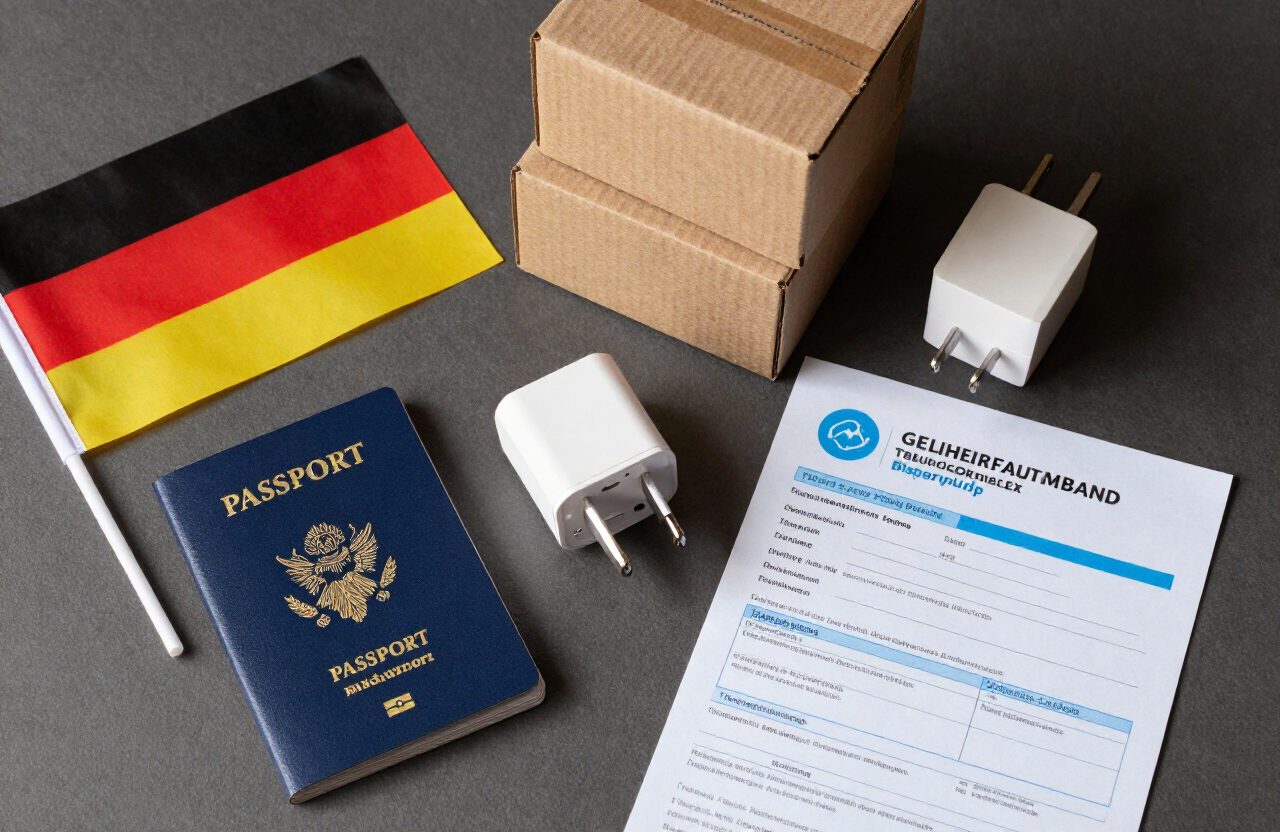
Moving from the United States to Germany is a multi-stage project, and the order in which you do things matters as much as the things themselves. This checklist walks you through the three phases that decide whether your move is smooth or stressful: the 3-to-6-month preparation window, the shipping and logistics decisions, and the first 30 days of German bureaucracy after you land. It covers the 90-day visa-free entry rule and where it stops applying, customs duty relief for your household goods (Übersiedlungsgut), the 120V vs 230V electronics trap, and the Anmeldung, bank account and Ausländerbehörde steps that follow. It is general guidance based on publicly published German federal, consular and customs sources — not individual legal or customs advice. Rules vary by nationality, purpose, and the local office handling your case, so always confirm the current requirements for your situation before you act.
Visa-free entry to Germany is not a residence permit. US citizens may enter for up to 90 days per 180-day period for tourism or business under the Schengen short-stay rule, but this grants no right to work and no automatic right to stay longer. Whether you can convert that entry into a residence permit from inside Germany depends on your purpose and circumstances — many routes require a visa issued by a German mission in the US before you travel.
Phase 1: 3 to 6 Months Before Moving
The preparation window is where most avoidable problems are created or prevented. Use it to confirm your passport, sort your visa route, apostille your US vital records, and line up health insurance. Work through the checklist below in order — each item feeds the next.
Check passport validity early
Your US passport must be valid for your entire stay. For a residence-permit application, German missions generally expect it to remain valid well beyond your intended stay — at least three additional months is the common practical minimum, and six months is safer. If yours is close to expiry, renew it before you start any visa paperwork, because the residence permit is tied to the passport you hold.
Confirm whether you need a visa before travel
Identify your purpose — employment, study, family reunification, freelancing, or job search — and confirm the route. The EU Blue Card, skilled-worker residence permit, student visa and family-reunification visa are normally applied for at the German embassy or consulate in the US before you fly. The Opportunity Card (Chancenkarte) for job seekers is also applied for before entry. A few categories may allow applying at the local Ausländerbehörde after entering visa-free, but this is not universal and is never guaranteed — confirm with the mission responsible for your jurisdiction.
Apostille US vital records
Germany is a party to the Hague Apostille Convention, so US public documents — birth, marriage and divorce certificates, and FBI background checks — need an Apostille, not full consular legalisation. Apostilles for state-issued documents are issued by the Secretary of State of the state that issued them; federal documents (like an FBI identity history summary) are apostilled by the US Department of State. Order these early, because state processing times can run to several weeks.
Arrange certified German translations
German authorities usually require a certified (sworn) translation of foreign documents that are not in German. The translation should be done by a translator sworn in Germany, or — if done in the US — later certified by a German court. Do not assume an English document will be accepted as-is; ask the specific office (mission, Bürgeramt, Ausländerbehörde) what it requires for your document type.
Arrange health insurance before arrival
German health insurance is a condition of most residence permits and is required from your first day. Employees above a salary threshold choose between statutory (gesetzlich) and private (privat) insurance; students, freelancers and the self-employed have their own rules. Confirm which proof your visa route and Ausländerbehörde accept, and arrange travel insurance to cover the gap between landing and the start of your German policy.
A note on the 90-day rule. US citizens can enter Germany and the wider Schengen area without a visa for up to 90 days within any rolling 180-day period, for short-stay purposes such as tourism, short business meetings, or visiting. The 90 days are counted across all Schengen countries combined, not per country, and the clock does not reset when you leave and re-enter. Crucially, visa-free entry does not grant the right to work for a German employer, and it does not by itself let you stay beyond 90 days. If your plan is to live, work or study in Germany, treat visa-free entry only as a short bridge and confirm your residence-permit route before you travel.
- Passport valid for at least 3–6 months beyond your planned stay; renew before any visa application.
- Visa route confirmed with the German mission responsible for your US jurisdiction — apply before travel where required.
- US vital records apostilled by the issuing state Secretary of State (or the US Department of State for federal documents).
- Certified German translations arranged for every foreign document your office requires.
- Health insurance proof ready, plus travel cover for the arrival gap.
Phase 2: Shipping & Logistics
Once your paperwork is in motion, decide what to bring and how to ship it. Two topics trip up Americans more than any other: the customs relief for household goods, and the voltage mismatch between US and German electronics. Get both right and you save money and avoid a box of fried appliances.
Customs Exemption for Household Goods (Übersiedlungsgut)
When you transfer your normal residence from the United States to Germany, your personal household goods can qualify for relief from customs duty and import VAT (Einfuhrumsatzsteuer) under the EU rules on personal property imported on transfer of residence — known in Germany as Übersiedlungsgut. This relief is not automatic: you must apply for it, declare the goods to German customs, and meet every condition. It is a relief you claim, not a right you walk through with.
| Condition | What it means in practice |
|---|---|
| Prior residence of at least 12 months | You must have lived in the US (or outside the EU customs territory) for at least 12 consecutive months before transferring residence to Germany. |
| Personal use for at least 6 months | The goods must have been owned and used by you personally for at least six months before the move. Brand-new items bought just before shipping may be denied relief and charged duty and VAT. |
| Import within 12 months | Goods should be imported within 12 months of you establishing residence in Germany. Later imports may lose the relief unless customs grants an extension for good cause. |
| No commercial use | The relief covers personal household effects, not goods intended for resale or commercial use. Items that look like stock for sale can be challenged. |
| Application form 0350 | You apply using customs form 0350 (Antrag auf Zollbefreiung), supported by proof of prior residence (e.g. US lease, utility bills, deregistration) and ownership/use. File it with the customs office responsible for your move. |
Vehicles, alcohol, tobacco and firearms are treated separately and have stricter or additional rules — a car, for example, has its own relief conditions and registration steps, and some items are simply restricted or prohibited. Do not assume a household-goods exemption covers everything in your shipment. Check the German customs (Zoll) guidance for your specific items, and if you are using a moving company, confirm who is responsible for filing form 0350 and presenting the goods.
Relief is decided case by case. Customs can deny duty/VAT relief for goods that do not meet the prior-use or prior-residence conditions, and you remain responsible for the accuracy of your declaration. Treat Übersiedlungsgut as a relief you apply for and document — not a blanket exemption.
US Electronics & Voltage Compatibility (120V vs 230V)
Germany runs on 230V at 50Hz; the United States runs on 120V at 60Hz. That single difference is why US hair dryers, kitchen appliances and many power tools will not work safely in Germany — and why a plug adapter alone is not enough for single-voltage devices. Before you pack anything with a plug, read the input rating printed on its power supply or nameplate.
Devices rated 100–240V — plug adapter only
Most laptops, phones, tablets, camera chargers and many electric shavers accept 100–240V, 50/60Hz. These work in Germany with only a plug adapter (Type C/F Schuko socket). Check the small print on the power brick: if it says 100–240V, you are fine. No voltage converter needed.
Devices rated only 120V — converter or replace
Hair dryers, curling irons, kitchen appliances, vacuum cleaners and many power tools are single-voltage 120V/60Hz. Plugging them into 230V without a step-down converter will damage or destroy them and is a fire risk. A voltage converter can step 230V down to 120V, but converters do not solve the frequency difference and are impractical for high-wattage heating appliances.
Two caveats that catch people out. First, frequency: even with a voltage converter, devices that depend on 60Hz AC — motorised appliances, clocks, some turntables and older electronics — run about 20% slower on Germany's 50Hz supply, and some may overheat. A converter changes voltage, not hertz. Second, wattage: high-wattage heating appliances (hair dryers, kettles, irons) draw so much current that a suitably rated converter becomes large, heavy, and often more expensive than simply buying the appliance new in Germany. For these, replacement is the safer and cheaper choice.
| Device type | Typical rating | What to do |
|---|---|---|
| Laptop / phone / tablet charger | 100–240V, 50/60Hz | Plug adapter only — works in Germany |
| Camera / shaver / toothbrush charger | Often 100–240V (check label) | Plug adapter only if dual-voltage |
| Hair dryer / curling iron | Usually 120V/60Hz only | Replace in Germany, or use a high-wattage converter (impractical) |
| Kitchen appliances (blender, mixer) | Often 120V/60Hz only | Replace in Germany — frequency affects motors |
| Clocks / turntables / older electronics | 120V/60Hz, frequency-dependent | Replace — 50Hz makes them run slow or malfunction |
The practical rule: check every label, bring dual-voltage devices with a plug adapter, and plan to replace single-voltage high-wattage appliances after you arrive. German plugs are Type C and Type F (Schuko); a US-to-Schuko adapter handles the physical shape but never the voltage.
First 30 Days in Germany: Critical Administrative Tasks
Once you land, a short chain of administrative tasks unlocks everything else — your bank account, your tax ID, your phone contract, and the legal validity of your residence. The order matters: registration comes first, because most of the rest depend on it.
- 01
Register your address (Anmeldung) at the Bürgeramt
Within 14 days of moving into your German home, register your address at the local Bürgeramt (Bürgerbüro in some cities). Bring your passport, the completed Anmeldung form, and the Wohnungsgeberbestätigung — the signed landlord confirmation that is legally required under § 19 BMG. Some cities give a little more time to book an appointment, but the duty to register promptly applies everywhere. Without Anmeldung you cannot get a tax ID, open most bank accounts, or finalise your residence permit.
- 02
Open a German bank account
With your Anmeldung confirmation and tax ID in hand, open a German bank account. Most landlords and employers expect a German IBAN for rent and salary, and many neobanks and traditional banks offer English-language onboarding for expats. Compare fees, English support and SEPA direct-debit features before you choose — and remember that as a US person you may face FATCA-related account questions.
- 03
Attend your Ausländerbehörde appointment
If you entered on a visa or need to convert or collect a residence permit, book your Ausländerbehörde appointment as early as possible — wait times vary widely by city and can be long. Bring your passport, biometric photos, proof of health insurance, proof of financial means, your rental registration, and any documents your specific permit requires. Appointment availability is municipality-specific, so do not assume a fixed timeline; book the moment you know your arrival date.
- 04
Sort health insurance and the radio tax
Confirm your German health insurance is active and that your insurer has your address. Then register with the Beitragsservice (formerly GEZ) for the Rundfunkbeitrag — the household broadcast fee every German home pays, regardless of whether you watch TV. It is per household, not per person, so coordinate with flatmates to avoid double charges.
- 05
Get your SCHUFA record started
A new arrival usually has an empty SCHUFA file, which is normal but can slow flat applications. Open a German bank account and a phone contract to start building positive entries, and request your free Datenkopie under GDPR Art. 15 to confirm what is on file. You do not need the €29.95 paid certificate for every viewing.
If you are hunting for a flat, the Anmeldung and a SCHUFA record feed directly into your application folder. Pair them with a German employment contract and recent payslips to strengthen your case in competitive markets — and read the line-by-line English translation of the Anmeldung form before your Bürgeramt appointment so nothing slows you down at the counter.
Frequently Asked Questions
Once your relocation timeline is set, line up the guides that cover the two things most Americans sort out next — the German banking setup and the US tax filing picture that follows you abroad.
Reviewed by the Expat Germany Guide editorial team
This guide is informational and based on publicly published German federal, consular, customs and municipal sources, including the German Residence Act (Aufenthaltsgesetz), Schengen short-stay rules, EU customs rules on the transfer of residence (Übersiedlungsgut, form 0350), and the Bundesmeldegesetz (BMG). Visa routes, customs relief conditions, document formalities, deadlines and appointment availability vary by nationality, purpose, and the local mission or office handling your case, and they change over time. This is general information, not individualized legal, customs or immigration advice — always confirm the current requirements for your situation with the German mission, Ausländerbehörde, customs office (Zoll) or Bürgeramt responsible for you before you act.