How to Get a Free SCHUFA Report in Germany (Datenkopie nach Art. 15 DSGVO)
Under GDPR Article 15 you have a right of access to the data SCHUFA holds about you — free of charge, no €29.95 certificate needed. Here is the verified request flow on meineschufa.de, what the Datenkopie contains, and how to handle it in apartment applications.
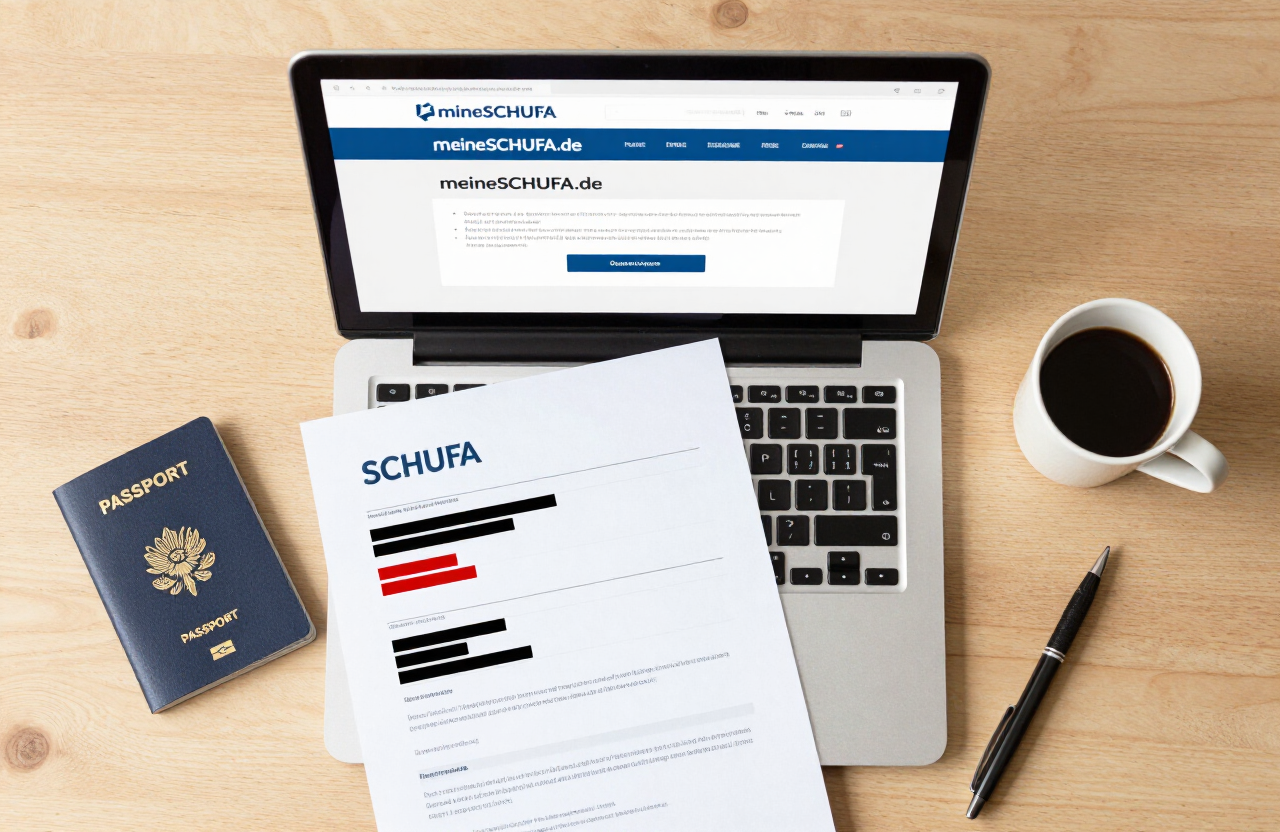
Every flat listing in Germany ends with the same demand: "Please send your SCHUFA." The first thing most expats do is search "SCHUFA", land on the official consumer portal, and meet a wall of paid packages — led by the €29.95 SCHUFA-Bonitätsauskunft that landlords traditionally ask for. Here is the part nobody tells you: under Article 15 of the GDPR (the DSGVO in German), you have a right of access to the personal data SCHUFA stores about you, and SCHUFA provides it free of charge as the Datenkopie nach Art. 15 DSGVO. This guide explains what a SCHUFA record actually is, walks you through the current request flow on meineschufa.de, and shows how to handle the document safely in an apartment application — without paying for a certificate you may not need.
What Is a SCHUFA Score — and Why Do Landlords Ask for It?
SCHUFA (Schutzgemeinschaft für allgemeine Kreditsicherung) is Germany's largest credit agency. Banks, telecommunications providers, retailers and landlords use SCHUFA data to assess how reliably a person meets payment obligations. When a landlord asks for "your SCHUFA", they are really asking for third-party proof that you have no serious negative entries (Negativmerkmale) — missed loans, collections, or disputed contracts — before handing over a lease.
What many newcomers miss is that SCHUFA runs two different things side by side: commercial products like the paid Bonitätsauskunft, and the statutory right of access under GDPR Article 15. The right of access is not a discount on the commercial product — it is a separate legal entitlement to see the personal data a company holds about you. It covers the data itself, not a polished report formatted for third parties.
Know the difference: the SCHUFA-Bonitätsauskunft (€29.95) is a commercial product designed to be shown to third parties such as landlords. The Datenkopie nach Art. 15 DSGVO is your statutory right of access — a snapshot of the data SCHUFA stores about you, which SCHUFA itself describes as serving your personal information. It is free of charge, but it is not automatically the document every landlord expects.
Don't Pay €29.95 Blindly: Free Datenkopie vs. Paid Bonitätsauskunft
| Feature | Free Datenkopie (Art. 15 DSGVO) | Paid SCHUFA-Bonitätsauskunft (€29.95) |
|---|---|---|
| Cost | €0 — free of charge | €29.95 per request |
| Legal basis | GDPR Art. 15 right of access | Commercial consumer product |
| What you get | A snapshot of the personal data SCHUFA stores on you, including a SCHUFA score calculated quarterly | A scored, formatted credit report intended for third parties |
| Delivery | By post — officially within about 5–7 days after successful identification | Within a few minutes by email |
| Intended use | Personal information: check your data, spot errors | Showing to landlords, banks and other third parties |
| Landlord acceptance | Varies — some accept it, others insist on the paid report | The traditional standard for flat applications |
The practical takeaway: before you pay for anything, ask the landlord or agent exactly which document they accept. Many are satisfied with confirmation that no negative entries exist; others in competitive markets insist on the scored Bonitätsauskunft. Knowing which one your target flat requires is the single biggest money-saver in the German apartment hunt.
Step-by-Step: Requesting Your Free Datenkopie on meineschufa.de
The request runs through meineschufa.de, SCHUFA's consumer portal — the dedicated service page is meineschufa.de/service/datenkopie, and SCHUFA also accepts requests through its consumer phone service. The exact screens can change, so follow the on-screen instructions; the five steps below reflect the published flow. For a condensed companion checklist, our quick Schufa record walkthrough compresses the same process.
- 01
Open the official Datenkopie page on meineschufa.de
Go to meineschufa.de and navigate to the "Datenkopie nach Art. 15 DS-GVO" service page. The paid packages are marketed more prominently than the free statutory option, so read the labels carefully and start the free request — not the subscription, and not the €29.95 Bonitätsauskunft.
- 02
Enter your personal details exactly as registered
Fill in your full name, date of birth, and current registered address — the details shown on your Meldebescheinigung. Even a small mismatch can delay the request while SCHUFA verifies who you are. If you moved recently, have your previous German addresses ready in case the form asks for them.
- 03
Complete the identity check (Legitimation)
SCHUFA must confirm your identity before releasing any data. The official identification routes include the online ID function (eAusweis/eID) of a German ID card, a PIN letter, and other legitimation procedures offered during the order — the exact options presented can vary. SCHUFA states that uploaded identity documents are deleted again after the check.
- 04
Confirm and submit the request
Review your entries — you get a final chance to correct them — and submit. Under the GDPR, SCHUFA must respond to an access request within one month at the latest; in practice the Datenkopie arrives faster once your identification is successful.
- 05
Watch your mailbox for the paper document
The Datenkopie is delivered by post — the official service page states delivery within about 5–7 days after successful identification and legitimation. Delivery times can vary, so request it well before your first apartment viewings rather than expecting an instant download. Store the document securely when it arrives; it contains sensitive personal data.
Apartment Applications: Sharing Your Data Safely
Handle it like a bank statement: the Datenkopie can contain sensitive personal data — stored scores, past credit inquiries, and contract and account records. SCHUFA positions it as a document for your personal information. Store it securely, never post it publicly or in open flat-viewing groups, and share it only with parties who genuinely need it.
Do not alter the document before giving it to a landlord. Blacking out or trimming content so the report appears different from what SCHUFA issued can misrepresent it — and a landlord who notices an edited report will question the whole application. If you are unsure how much the Datenkopie reveals, ask the landlord what specific proof they actually need before you send anything. Many only want confirmation that no negative entries exist; some accept the Datenkopie for that, while others insist on the paid Bonitätsauskunft because it is the official tenant-facing product.
- Ask first: message the landlord or agent and ask which SCHUFA document they accept before you order or pay for anything.
- If they accept the Datenkopie, bring a copy to the viewing and take it back with you afterwards rather than leaving it behind.
- If they insist on the scored report for third parties, that is the paid SCHUFA-Bonitätsauskunft — a one-off €29.95 purchase, no subscription needed.
- Never send full financial documents over unsecured channels or to unverified "landlords" — rental-application fraud is common in tight housing markets.
What If You Have No SCHUFA History Yet?
If you arrived in Germany recently, your SCHUFA record may be empty — and that is completely normal. A record only grows as business partners report contractual data, so a newcomer simply has not had time to generate entries. An empty Datenkopie is not a red flag; it is a blank slate, and many landlords understand this for expat applicants.
- Request the Datenkopie anyway — an official document confirming "no data stored" is stronger than a verbal "I just arrived."
- Add a short cover note explaining you recently relocated and have not yet built a German credit record.
- Strengthen your application folder with a German employment contract, recent payslips, and a reference from a previous landlord abroad.
- Give it time — there is no shortcut that instantly creates a SCHUFA history, and any service promising one is not worth your money.
Building a German Credit Record From Day One
What actually ends up at SCHUFA is contractual data reported by business partners — for example loan agreements, current accounts with credit features, telecom contracts, and mail-order or instalment purchases. Opening a bank account or paying your rent on time does not automatically create a SCHUFA entry or a score: companies decide what they report, and SCHUFA determines what it stores. What you can control is avoiding the negative entries that actually damage an application.
- Pay every contract on time — missed payments and collections are the entries that hurt, and they can be reported.
- Keep your address current with banks and telecom providers after every move, so notices and reminders actually reach you.
- Check your Datenkopie periodically to spot wrong or outdated entries — under GDPR Art. 16 you can request rectification of incorrect data.
- Do not sign up for contracts or credit you do not need just to "build a score" — there is no guaranteed payoff, and every credit application can itself be stored as an inquiry.
For the everyday side of settling in, compare accounts and pick a German bank account that fits expat life — choose it for banking, not for any promised score effect.
Frequently Asked Questions
Reviewed by the Expat Germany Guide editorial team
This guide is general information, not legal or financial advice. It is based on publicly available sources checked in October 2026, including the official meineSCHUFA Datenkopie service page (meineschufa.de/service/datenkopie), SCHUFA consumer information at schufa.de, and guidance on the GDPR right of access from the German Federal Commissioner for Data Protection and Freedom of Information (BfDI). Request flows, identification procedures, delivery times, and product names can change — always follow the instructions on the official SCHUFA portals, and contact SCHUFA's consumer service or a qualified adviser for your individual case.